

This September marks twenty-five years since the attacks of 11 September 2001. While the anniversary serves as a moment of remembrance, it also highlights a critical lesson that remains relevant today: terrorist acts require resources. Behind terrorist activity frequently lies a need for financial and other material support enabling activities such as recruitment, training, travel, propaganda, living expenses, logistics and operational activity.
As highlighted in the FIAU’s Guidance Document on the Funding of Terrorism, identifying and disrupting the flow of funds or other assets connected with terrorism is an important component of preventing and countering terrorist activity. Identifying and reporting suspicious financial behaviour can therefore play a crucial role in safeguarding national and international security.
Understanding Terrorist Financing.
The FIAU’s guidance explains that funding of terrorism involves making funds or other assets available, directly or indirectly, to support terrorist activities, including where there is intention, knowledge or reasonable cause to suspect that the funds may be so used.
Unlike money laundering, terrorist financing does not necessarily involve proceeds derived from criminal activity. Funds may originate from both lawful and unlawful sources. Business earnings, salaries, charitable contributions, voluntary donations and other legitimate funds may be used or diverted towards terrorist purposes, alongside proceeds arising from criminal activity.
This distinction is significant because it means that terrorist financing often does not display the same characteristics commonly associated with money laundering. Rather than focusing solely on the source of funds, subject persons must also consider the purpose and destination of transactions.
How Terrorist Organisations Raise and Move Funds?
According to the FIAU’s guidance, terrorist organisations employ a variety of methods to obtain, transfer and store funds. These methods may include:
- Legitimate businesses operated or controlled by terrorist groups;
- Donations from supporters and sympathisers;
- Abuse of charitable or non-profit organisations;
- Cash couriers and informal value transfer systems;
- Criminal activities such as fraud, extortion, trafficking and hostage-taking and other offences.
The guidance shows that terrorists and terrorist organisations may use a variety of legitimate, misused legitimate and criminal activities to raise funds, and may use both formal and informal channels to move them. This makes the identification of terrorist financing particularly challenging, as transactions may appear legitimate when viewed in isolation.
Learning from Case Study 1.
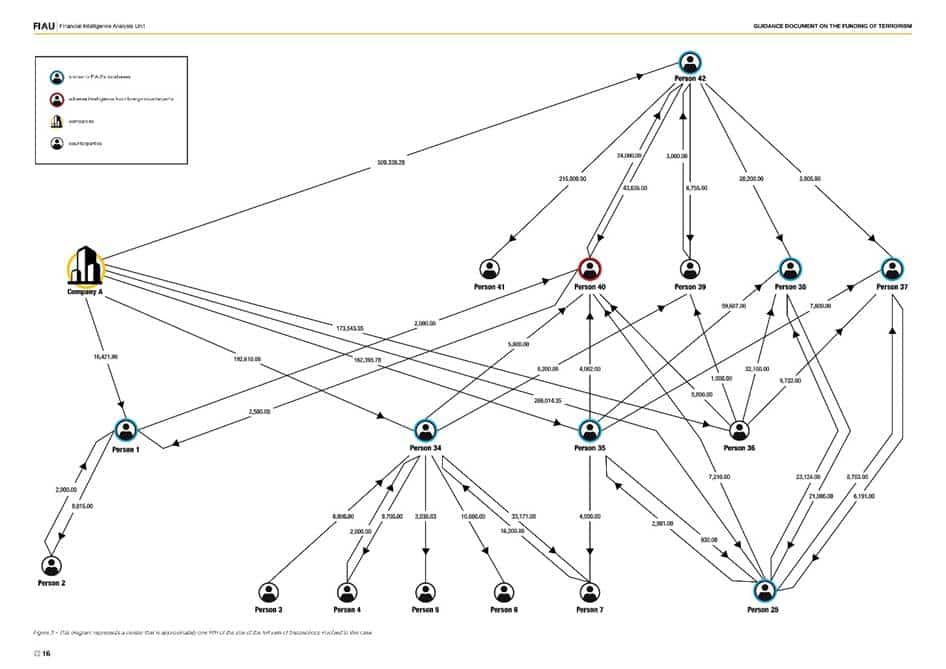
Case Study 1 concerns a number of employees of the same company who maintained accounts with a Maltese credit institution. Their employer operated in a high-risk jurisdiction and in an industry internationally recognised as presenting a high ML/FT risk. However, the customers had not initially been classified or monitored as presenting higher risk.
The credit institution subsequently identified a pattern of significant transfers moving back and forth among the customers. The transactions were described as loans and loan repayments, but the institution considered that they lacked economic or logical sense and appeared designed to disguise the audit trail. Further checks established that reputable media sources had linked the customers’ common employer to a designated terrorist group. The institution reported the activity, following which the FIAU commenced its own analysis.
Figure 3 illustrates the scale and complexity of the resulting analysis. The FIAU describes the diagram as representing a cluster approximately one-fifth the size of the full web of transactions involved in the case. Even as a partial representation, it demonstrates the importance of examining relationships among customers, counterparties and transactions collectively.
The case underlines the need for effective customer risk assessment, appropriate ongoing monitoring and attention to transactions that lack economic or logical sense. It also demonstrates how common links, transaction patterns, adverse media and other available intelligence may become significant when assessed together.
Recognising Potential Indicators.
The FIAU guidance stresses the importance of adopting a risk-based approach when assessing potential terrorist financing indicators.
Examples of activity that may warrant further scrutiny include:
- Transactions that appear inconsistent with the customer’s profile;
- Multiple small donations or transfers directed towards high-risk regions;
- Funds being transferred through several intermediaries without a clear economic rationale;
- Unexplained links to jurisdictions known for terrorist activity or conflict;
- Customers displaying unusual secrecy regarding the purpose of transactions;
- Unusual cash deposits, withdrawals or cash-intensive activity that is inconsistent with the customer’s profile or lacks a reasonable explanation.
While no single indicator necessarily establishes suspicion, indicators must be assessed holistically and, on a case-by-case basis. Where the subject person knows, suspects or has reasonable grounds to suspect that funding of terrorism may be taking place, an STR must be submitted immediately to the FIAU.
The Role of Financial Intelligence.
The FIAU’s guidance emphasises that terrorist financing is often detected through the analysis of financial intelligence rather than through the identification of large or obviously illicit transactions.
Financial information can reveal relationships between individuals, entities and jurisdictions that may otherwise remain hidden. For this reason, subject persons serve as a critical first line of defence in identifying unusual activity and reporting suspicions.
The effectiveness of counter-terrorist financing measures therefore depends upon strong cooperation between reporting entities, supervisors, law enforcement authorities and Financial Intelligence Units. Individual reports may appear insignificant when viewed independently, yet collectively they can uncover broader terrorist financing networks and support preventative action.
A Shared Responsibility.
Twenty-five years after 9/11, the threat landscape continues to evolve. However, one principle remains unchanged: terrorist organisations require access to funds in order to operate.
The FIAU’s Guidance Document on the Funding of Terrorism highlights that these funds may originate from legitimate or illegitimate sources, move through legitimate or informal channels, and often involve activity that appears ordinary at first glance. This reality makes vigilance, due diligence and effective reporting essential components of the fight against terrorism.
As we remember the events of 11 September 2001, we are reminded that the disruption of terrorist financing remains one of the most effective preventative tools available. Understanding how funds are raised, moved and utilised can help protect the integrity of the financial system and ultimately contribute to the prevention of future harm.